
Dredger information
A dredger is a powerful pump mounted on floating pontoons and designed for underwater soil excavation with further transportation of the slurry to the placement area.
A wide range of operating conditions and project requirements leads to a broad product line. When selecting a dredger, the soil type, dredging depth, transport distance, loosening method, layout, control system, and available power supply all matter.
Where dredgers are used
- cleaning ponds, rivers, lakes, and other water bodies from bottom sediments;
- strengthening shores, dams, and hydraulic structures;
- extracting sand, gravel, sapropel, precious metals, and stones;
- hydraulic filling of dams, beaches, roads, and construction sites;
- trenching for pipelines, cables, and siphons;
- cleaning industrial and agricultural settling ponds from silt, sand, and other deposits;
- works in ports, canals, basins, and other hydraulic engineering facilities.
What affects model selection
- natural conditions and water body type;
- soil category and required excavation method;
- dredging depth and slurry transport distance;
- available power supply: diesel, electric, or combined;
- type of soil intake system and number of slurry pumps;
- hull design, equipment layout, and onboard accommodation requirements.
Soil categories
- Category I: 90% of compacted sand, 10% of light-textured loam soil;
- Category II: 60% sand, 40% medium-textured loam;
- Categories III-IV: 70% heavy loam, 30% sand;
- Categories V-VI: 90% heavy clay, 10% sand.
Design and equipment
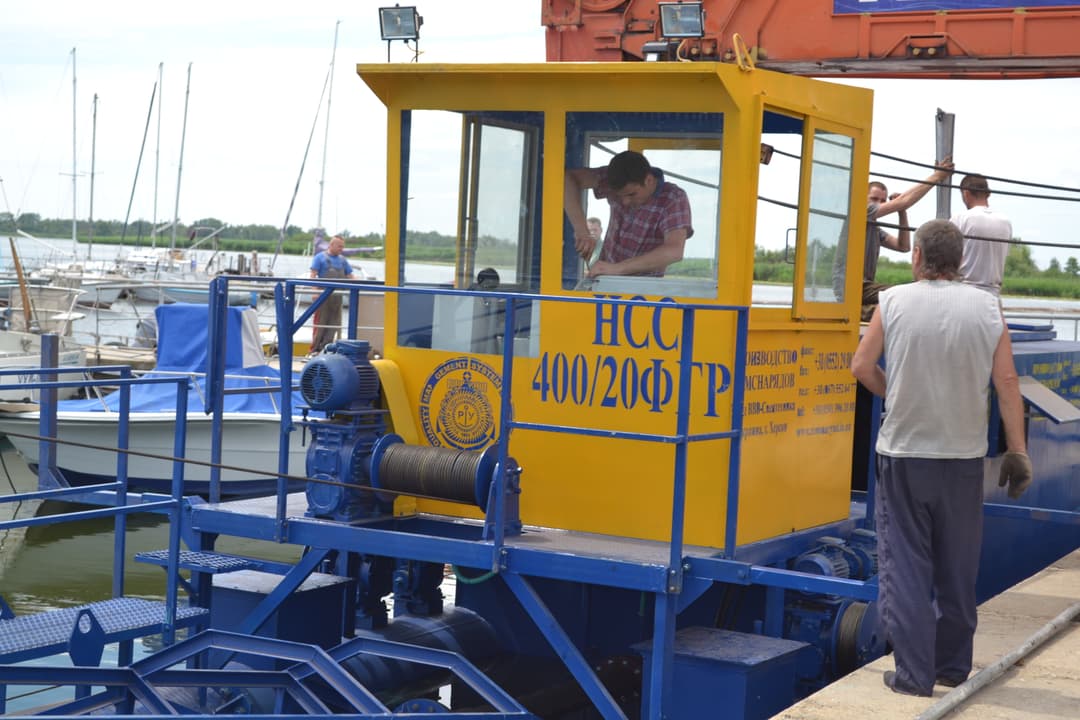
A dredger typically combines power units, pumps, control systems, and the soil intake device placed on a main pontoon with side pontoons or inside a non-detachable hull structure.
Modern onboard equipment allows operators to control the mechanisms from the wheelhouse. Standard operations, process monitoring, and emergency stops are performed from the control panel.
Depending on the model, dredgers may include accommodation spaces, additional pumps, modified suction systems, and specialized working tools.
HCC dredger options and accessories
- Suction head (F) – a cutter - is a construction meant for development of the soil of the I – VI categories with the help of hydraulic cutterhead with the capacity from 16 to 100 kWt and rotation frequency from 4 to 40 rev. in at 1200-3500 n/m3. The foundation is a displacement-type frame. The distinctive feature of the frame is the availability of pontoons in metallic structure that allows to perform soil development on the depth up to 15 m due to load reduction of the hull and suspension of hydraulic dredger.
- Hydraulic washing-out (hydraulic ripper or jet) indicated with the letters GR is meant for development of soil of the I-IV categories. The capacity of installed pump that supplies water to the end of the arrow of suction drum is different from 2 kWt to 40 kWt; water supply is from 12 up to 200 m3 per hour at hydraulic drop of water column from 30 to 80 m
- Capsular hydraulic dredger (K) – is a hydraulic dredger with the capsule (dimensions according to the pump) in the engine department which sinks under the water to the depth from 1 to 3 m of hydraulic dredger draught with the help of hydraulic cylinder. In the process the concentration of pulp increases for 15-20% of concentration of pulp of an ordinary hydraulic dredger. The depth of soil development increases up to 15 and more meters. The concentration of pulp increases at the expense of absence of atmospheric resistance during the suction of soil.
- Modified dredger (M) - modified capsular dredge excavation to the depth of 20 m and the concentration of the pulp density from 1.4 to 1.8 kg / l, but this decreases the transportation distance of the pulp.
Standards and regulations
- The State Standard of the Union of Soviet Socialist Republics “Hydraulic dredgers of general purpose. Terms and definitions. GOST 17520–72”.
- GOST 26433.0-85 “Rules for performing measurements. General provisions”.
- GOST 26433-89 “Rules for performing measurements. Elements of prefabricated structures”.
- Ukrainian National Construction Regulation DBN B.1.1-7-2002 “Fire Safety Regulations”.
- "Rules for Construction and Equipment of Ships" ND 31.0.020-2004.
- "Rules for Classification and Construction of Inland Waterway Vessels (PSVP)".
- "Rules for Classification and Construction of Small Craft".
- "Rules for Classification Surveys of Vessels".
- "Guidelines for Technical Supervision of Welding Application in Shipbuilding and Ship Repair".
- "Small Craft. Principal Data" ISO 8666:2002.
- "Small Craft. Stability and Buoyancy Assessment and Classification. Part 1".
- "Non-sailing Boats of Hull Length Greater Than or Equal to 6 m" ISO 12217-1:2002.
- "Small Craft. Maximum Load Capacity" ISO 14946.
- "Small Craft. Permanently Installed Diesel Engines. Fuel and Electrical Equipment Mounted on the Engine" ISO 16147:2002.
- "Unified Safety Rules for Open-Pit Mining Operations" PB03-498-02.